


Why does asking AI to polish your draft often feel more exhausting than writing it yourself?
Because wholesale rewrites steal your control. When a chatbot replaces your work with an all-or-nothing draft, it creates an exhausting auditing chore. You get stuck doing forensic reading. Hunting for dropped points, checking unprompted edits, and watching your distinct business voice get flattened into generic corporate-speak.
Inline suggestions fix the dynamic. The AI proposes small, targeted tweaks right on the page. You see what is added. You see what is cut. You stay in control of every single change.
Want to understand the cognitive science behind the burnout, and see the research on why inline suggestions save you time? Dig into the full article below.
The Two-Second Trap: When AI Rewrites Erase You
You know how this goes.
It is late on a Tuesday. You just spent an hour drafting a proposal for a client you really want to land. Or maybe you were writing an email newsletter to your customer list. You know what you want to say. The reasoning is solid. The offer makes sense. But the rhythm in the third paragraph feels a bit clunky, and one sentence runs on too long.
You copy the draft into an AI chatbot. You type a simple request: "Make this sound more professional and tighten the flow."
Two seconds later, your screen flashes. A shiny, new wall of text appears.
At first glance, it looks impressive. The sentences are smooth. The grammar is spotless. But as you read the opening lines, your stomach drops. Where did your direct tone go? Why is it suddenly using words like "delve," "tapestry," and "testament"? Why does your lean, practical consulting firm suddenly sound like a mid-level insurance brokerage?
What just happened is something researchers call procedural collapse [1].
Standard AI interfaces do not sit beside you as a writing partner. They act like an over-eager intern who takes your draft, shreds it, and hands you an entirely new document written from their own point of view [2]. They replace the messy, step-by-step drafting process—where you actually test ideas, choose emphasis, and refine your arguments—with a single, monolithic answer [1].
Did you actually save an hour of your workday? Or did you just hand yourself a brand-new, exhausting job?
When an AI rewrites your page from scratch, it does not erase the work. It simply moves the friction from typing words to reviewing a stranger's draft [1]. For a solopreneur or small business owner, that tradeoff is dangerous. Your voice is your brand. It is your handshake with your market [2]. When you let a model pave over your draft with an all-or-nothing rewrite, you lose the very nuances that make people want to work with you [2].
There is a much better way to work. It starts by recognizing why full rewrites feel so draining—and why treating AI as an inline editor gives you back your time and your voice.
The Brain Drain of "Forensic Reading"
When a chatbot spits out a full rewrite, what is the first thing you have to do?
You have to compare the new version against your original text, sentence by sentence [2]. Did it keep your pricing breakdown? Did it preserve that specific guarantee you spent twenty minutes framing? Did it soften your pitch so much that the call to action disappears?
You are not editing anymore. You are doing forensic reading [2][3].
Hunting line by line through an unfamiliar draft is deeply exhausting. There is a clear psychological reason for this fatigue: it breaks the basic rules of how our minds process information [4].
In 1988, educational psychologist John Sweller introduced Cognitive Load Theory [4]. His research showed that human working memory is remarkably small. While earlier theories suggested we could hold seven pieces of information at once, later research by Nelson Cowan proved the real limit is closer to just four meaningful chunks [4].
Four chunks. That is your entire mental workspace.
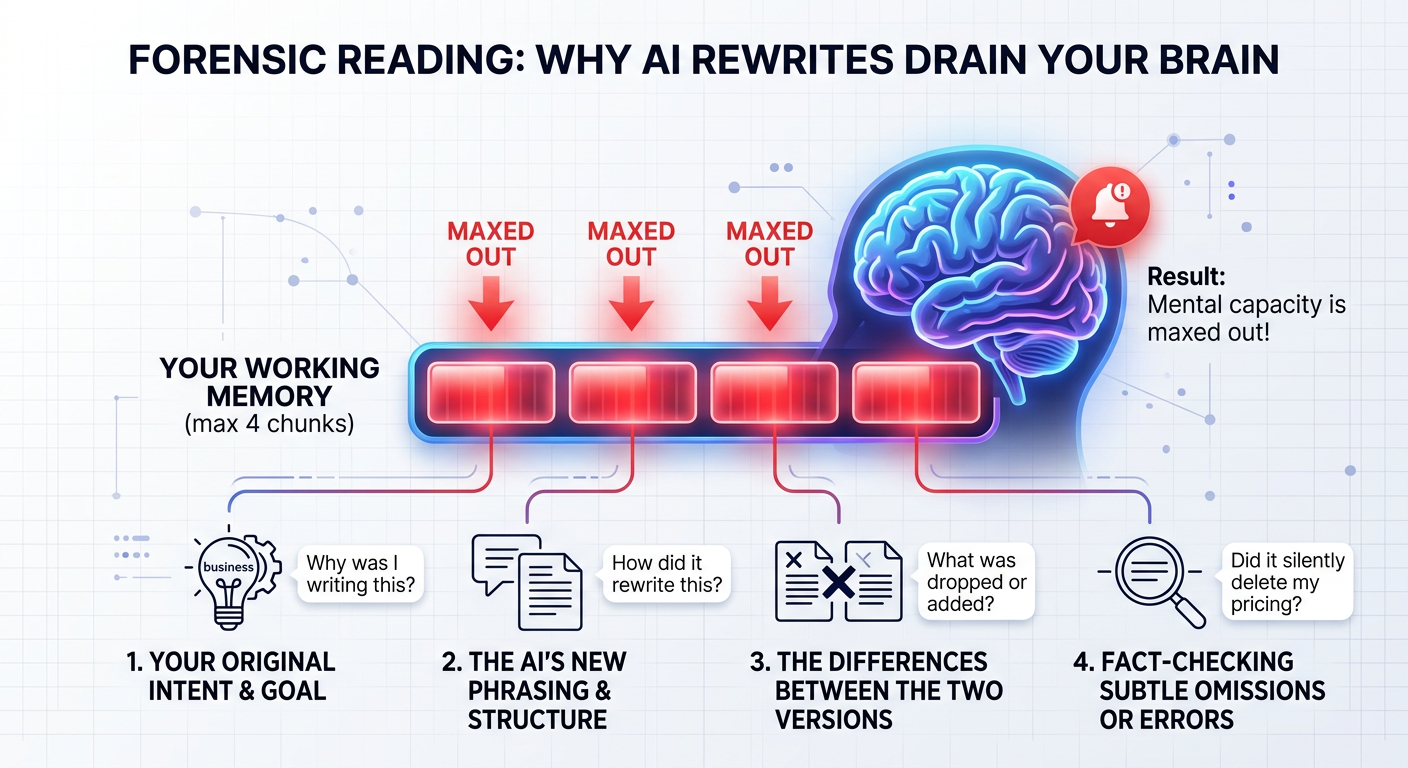
When you try to compare a rewrite with your original thought across different windows or browser tabs, you trigger what Sweller called the split-attention effect Cognitive Load Theory: Why AI Is Drowning Your Brain [4]. Your brain has to juggle your original objective, the AI's foreign phrasing, the differences between them, and the surrounding business context all at once [4]. Under that level of extraneous mental strain, human performance degrades by up to 40% [4].
Recent peer-reviewed research confirms just how heavy this auditing penalty really is. In late 2025, researchers developing the Cognitive Load Scale for AI-assisted writing (CL-AI-L2W) mapped out where mental effort actually goes during AI collaboration [5][3]:
Critical Evaluation—the effort of auditing, fact-checking, and assessing AI text for relevance and tone—was the single most demanding activity, scoring an average of 4.81 out of 7 [5].
Prompt Management—the mental gymnastics of phrasing, iterating, and troubleshooting prompts—ranked second at 4.55 out of 7 [5].
Integrative Synthesis—blending AI text back into your draft while protecting your voice—scored 4.40 out of 7 [5].
Authorial Core Processing—the natural human act of outlining your ideas, choosing your position, and drafting sentences—demanded the least strain, scoring just 3.48 out of 7 [5].
Think about what those numbers mean. The mental work of second-guessing and checking an AI rewrite drains significantly more energy than simply thinking through the problem and writing your own sentences [5][3].
What happens when your working memory is overloaded? You burn out. You stop checking [4]. You slip into automation bias: you accept the AI's words simply because your brain is too depleted to keep evaluating them [4][3].
Have you ever hit "send" on a proposal you didn't quite love, just because you were tired of fighting the chatbot's draft? That isn't a lack of discipline. It is cognitive overload caused by an interface that replaces your thoughts instead of suggesting adjustments [4][1].
The "Beigeification" of Your Business Voice
Beyond draining your brain, full rewrites quietly erode the personality of your company.
When you run a small business or work as an independent consultant, your specific perspective is your moat. If a prospect wanted boilerplate corporate jargon, they could hire an agency or search an online directory. They want your insight. They want your quirks, your directness, and the clear point of view that comes from running your operation every day.
Large language models do not care about your moat. They are designed to predict the next most statistically probable word [6]. By definition, they pull toward the middle. They sand off the edges.
This isn't an impression; it is an established scientific fact. In a landmark study published in Nature Human Behaviour, researchers examined how AI models reshape human expression across 880,000 texts [6][3]. The findings were striking:
Linguistic Diversity Plummets: When LLMs polish or rewrite text, they reduce the variance of linguistic complexity by a statistically significant 21% to 50% ($p \le .05$) across models and domains [6].
Meaning Stays, Voice Dies: Around 87% of rewritten texts kept high semantic similarity (cosine similarity over 0.95) to the original [6]. The core information survived, but the stylistic individuality was ironed flat [6].
Identity Markers Vanish: Classifiers trained to identify author traits—such as personality dimensions, age brackets, and values—suffered a 6% drop in predictive accuracy on rewritten drafts [6]. The models systematically stripped unique author markers and pushed every text toward a generic, older, more formal corporate baseline [6].
As computer scientist Zhivar Sourati noted when discussing the findings, AI chatbots produce standardized expressions and thoughts across users, subtly reshaping what passes for credible communication AI is homogenizing human expression and thought [7].
In the business world, this phenomenon has a name: the "beigeification" of content [2]. Websites, cold emails, case studies, and pitch decks have begun to sound identical.
To make matters worse, models suffer from session drift Brand Voice in the AI Era [8]. As a chat conversation grows, context window dilution sets in [8]. After generating 3,000 to 5,000 tokens, the AI's attention decays, and it slips back into its default training patterns [8]. You can give it a 20-page brand guide, but by reply number five, it is back to generating the same corporate drone as every other tool [8].
Does that generic drone actually work in the market?
The numbers show it does not. In a controlled publishing comparison, authentic human-edited messaging converted at 2.5%, while automated text conversions trailed at 2.1% [9]. On long-form articles, authentically edited writing kept readers on the page 20% to 25% longer [9]. Furthermore, when readers know a text is machine-written, perceived message credibility drops noticeably (an effect size of $d \approx 0.36$) [9].
Can your business afford to sound like an average of the entire internet? If your proposal reads like it was cranked out by an algorithm, why should a client trust that your work will be any different?
The Hidden Landmines: Hallucinations and Silent Cuts
There is an even bigger problem with handing your draft to an AI for a complete rewrite: the model will change things you never asked it to touch.
When an AI rewrites an entire document, it does not just polish sentences. It makes editorial judgments on its own. It decides which ideas matter, which clauses can be cut, and how arguments should be framed. And very often, its judgment is poor.
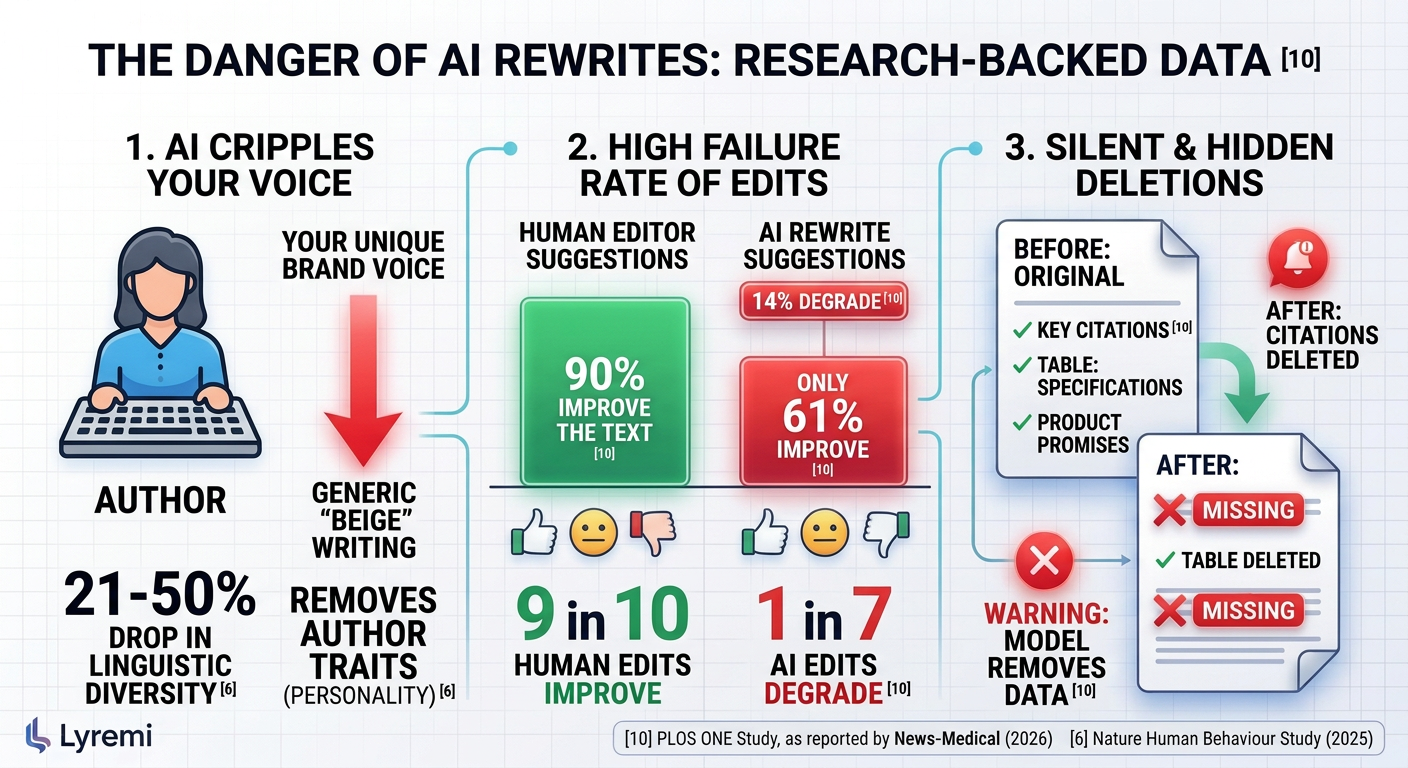
Consider a rigorous copyediting study published in PLOS ONE, reported by AI editing tools make more corrections but reduce writing quality [10][3]. Researchers tested generative copyediting from ChatGPT against an inline grammar tool (Grammarly) and a professional human editor working on research drafts [10].
The results were eye-opening:
More Volume, Worse Judgment: ChatGPT prompted roughly three times as many corrections as the human editor and ten times as many as the inline tool [10].
High Failure Rate: Of the 83 readability revisions suggested by ChatGPT, only 61% actually improved the writing [10]. Another 24% had no real impact, and 14% actively degraded the quality of the text [10]. By contrast, 90% of the human editor's targeted suggestions made the draft better [10].
Silent Deletions: In its quest to make the prose look neat, ChatGPT quietly deleted citations and an entire table reference from the manuscript [10].
Think about what a silent cut means for your business.
What happens if an AI rewrites your statement of work and quietly deletes a crucial milestone? What if it rewrites a client agreement and leaves out a liability disclaimer because it thought the sentence looked wordy? What if it alters the technical specs of your product pitch just to make the paragraph flow faster?
Catching those errors requires immense mental effort. In the MindCopilot co-writing framework, computer scientists introduced a metric called Knowledge-aware Editing Distance (KED) [11]. KED measures the cognitive effort required to repair an AI suggestion after it introduces factual or logical errors [11]. It correlates strongly with human editing time (Pearson $r = 0.686$, Spearman $\rho = 0.786$), proving that fixing an AI's distorted facts takes far more mental energy than fixing simple grammar [11].
The time penalties are just as real. In that same copyediting trial, generating and auditing a track-changes document to verify ChatGPT's rewrite took 30 minutes, whereas reviewing inline suggestions one by one took just 5 minutes [10].
Why take on the heavy chore of fixing an AI's unprompted mistakes?
When you use an inline suggestion workflow, you keep your structural scaffolding intact [3][11]. You don't have to worry about silent deletions or altered facts. The model suggests a tweak to a specific sentence, right where you are reading. You see what goes out. You see what comes in. You remain in complete control of every single change [12][2].
Full Rewrites vs. Inline Suggestions: A Side-by-Side Look
When you look at your weekly schedule, where would you rather spend thirty minutes? Building your business, or playing forensic detective against an overzealous chatbot?
The differences between an all-or-nothing rewrite and a targeted, suggestion-based workflow are not subtle. One forces you to surrender control. The other treats you like the boss.
Editorial Dimension | Wholesale Chatbot Rewrite | Inline Suggestion Workflow |
|---|---|---|
Control & Agency | All-or-nothing. The AI replaces your entire draft, stripping authorial autonomy [2][3]. | Complete. You hold explicit authority over every single document change [12][11]. |
Cognitive Friction | High. Triggers the split-attention effect and forces forensic line-by-line diff-checking [4][3]. | Low. Keeps you in flow by isolating small, readable edits right on the page [3]. |
Window Switching | High disruption. Users average 15.76 window switches per task in controlled benchmark tests. | Minimal disruption. Drops to 8.15–8.92 window switches per task [11]. |
Task Completion Time | Slower overall. Averages 46.42 minutes on standard writing tasks due to heavy evaluation friction. | Faster overall. Drops to 31.07–32.85 minutes on identical tasks [11]. |
Brand Voice | Collapses into an average, generic corporate register [6][8]. | Preserves your original style, argument architecture, and personality [8]. |
Notice that drop from 46 minutes down to 31 minutes [11]. That is not just about raw typing speed. It is about mental stamina. When your software presents edits as clear, discrete choices, you finish drafting with energy left over to actually run your company.
Keeping You in the Composer’s Seat with Lyremi
You built your business on your intuition and hard-earned expertise. Why let an algorithm bulldoze your voice?
Lyremi is designed around a simple, non-negotiable premise: you are the composer [12]. Your files stay at the center of the workspace, everything the system creates belongs to you, and the rule never changes: nothing changes in your work unless you say so [12].
Instead of generating a detached block of replacement prose in a chat window, Lyremi treats writing as an ongoing collaboration between you and your assistant [12].
How the Suggestion Workflow Works in Practice
Here is how you actually edit a high-stakes proposal, client update, or blog post inside Lyremi without losing your rhythm:
Ask right inside your doc: Open the chat panel next to your document. Tell the assistant what you want to improve—whether that means tightening up a clumsy paragraph, smoothing out an abrupt transition, or cutting excess fluff [12].
Review inline suggestions: Changes never land silently [12]. Proposed edits show up directly on your draft as visual suggestions, displaying exactly what text would be removed and what would be added [12].
Make the call: You evaluate each change in its real context. Click Accept if the tweak sharpens your sentence [12]. Hit Reject if it dulls your voice [12]. If a whole batch of surface cleanup looks spotless, choose Accept all to save time [12].
You never have to guess what disappeared. You simply take the good ideas and drop the rest.
Built-In Guardrails for Busy Founders
What happens when you accept an edit under deadline pressure, only to realize the next morning that your original phrasing was punchier? In business, second thoughts happen.
Lyremi protects you with two essential guardrails:
Version history: You are never locked into a bad decision. Lyremi keeps your earlier drafts intact [12]. You can open version history at any moment, review what changed, and restore a previous version with a single click [12].
Project Knowledge: Chatbots naturally drift back toward generic phrasing over long sessions as context windows fill up. In Lyremi, you can lock in your style guide, audience notes, and brand voice rules under your project's Knowledge [12]. Every chat, draft, and suggestion inside that project automatically adheres to your rules [12].
Have you ever wondered what your business communication would look like if AI helped you write faster without speaking for you?
You do not have to settle for the beige, generic drone of full AI rewrites. You can test this workflow yourself today on the Free plan [12]. Drop your next proposal or sales email into Lyremi, ask for a polish, and experience the relief of making every final call yourself.
Sources
AI Systems Hide the Work, Making Verification the New Bottleneck – Kim, J., & Mei, K. X. (2026). HCI Index / arXiv:2608.17326.
Co-Writing with AI, on Human Terms: Aligning Research with User Demands Across the Writing Process – Reza, M., Thomas-Mitchell, J., Dushniku, P., Laundry, N., Williams, J. J., & Kuzminykh, A. (2025). ACM PACMHCI / arXiv:2504.12488.
Evidence for Suggestion-Based AI Editing Over Wholesale Rewrites – Lyremi Research Agent Brief (2026).
Cognitive Load Theory: Why AI Is Drowning Your Brain – The Clearing AI / Sweller, J. (2026).
Cognitive load scale for AI-assisted L2 writing: scale development and validation – Yao, G., & Fan, L. (2025). Frontiers in Psychology / PMC: PMC12611650.
The Shrinking Landscape of Linguistic Diversity in the Age of Large Language Models – Sourati, Z. et al. (2025). Nature Human Behaviour / arXiv:2502.11266.
AI is homogenizing human expression and thought, computer scientists and psychologists say – Cell Press / Sourati, Z. et al. (2026). Trends in Cognitive Sciences / EurekAlert!.
Brand Voice in the AI Era – University 365 Institute of Communication (2026).
Human Editors vs AI Humanizers: Research Comparison for 2026 – EssayService Research Investigation (2026).
AI editing tools make more corrections but reduce writing quality – August, E. et al. (2026). PLOS ONE / News-Medical Life Sciences.
MindCopilot: Towards Formalizing and Evaluating Granular Human-LLM Co-Writing – Fang, Y. et al. (2026). arXiv:2605.23535.
Lyremi: How It Works – Lyremi Workspace Documentation & Assistant Reference Manual (2026).