


We tend to think that giving AI more information makes it smarter. It makes sense, right? If you want a comprehensive answer, you provide a comprehensive background. You upload the strategy deck, the meeting transcripts, and a massive corporate wiki.
But loading massive amounts of information into an AI prompt actually does the opposite. It stretches the model's attention thin and significantly degrades its output Effective context engineering for AI agents [1].
Empirical research shows a harsh reality. As context grows, large language models suffer sharp drops in reasoning accuracy, factual retrieval, and instruction-following [1]. This happens even when they operate well within their advertised context windows Context Length Alone Hurts LLM Performance Despite Perfect Retrieval.
In workplace tools, this degradation causes massive friction. It leads to conversational drift, hallucinated variables, and silent omissions. This creates serious operational risks What Is Context Rot?. Instead of speeding up work, human workers get trapped in an exhausting verification bottleneck. We burn our time and cognitive energy auditing flawed generations rather than actually doing productive work.
Are we actually automating work, or merely trading writing time for tedious error checking? Unchecked context stuffing exhausts teams. It erodes human judgment. Worse, it stalls enterprise automation initiatives before they deliver value Gartner: only 40% of CIOs guard against AI dulling staff judgment [1].
The Illusion of Infinite Context Windows
Every few months, tech companies announce a new, massive context window for their latest model. First it was 32,000 tokens. Then 128,000. Now we see claims of over a million tokens. The marketing pitch is incredibly tempting. Just drop your entire codebase or a year's worth of financial reports into the chat, and let the AI figure it out.
But this marketing creates a dangerous illusion.
Having the raw capacity to hold a million tokens is not the same as having the ability to understand and reason across them. Treating a context window like an infinite junk drawer creates serious failures. We hit the model's Maximum Effective Context Window, or MECW [1].
The MECW is the actual threshold where a model's accuracy holds up. According to data governance firm Atlan, this effective window often falls short of those flashy advertised limits by up to 99% when the AI is asked to do complex tasks LLM Context Window Limitations in 2026. In a typical enterprise query, you might load in schema definitions, data lineage graphs, and permission policies. These alone can burn between 50,000 and 100,000 tokens before the core reasoning even starts [1].
When you push an AI past its effective limit, a phenomenon called "context rot" sets in What Is Context Rot?. The model becomes overwhelmed. It stops actively weighing the importance of every word. Instead, it skims. It guesses. It loses the thread of what you actually asked it to do [1].
Think of reading a 200-page legal brief in one sitting. By page 150, you are skimming. Words blur together. Models face that exact saturation when overloaded with enterprise text. Feeding models uncurated, static metadata only accelerates this context rot [1]. Managing what you put into the prompt is far more critical than how much the prompt can technically hold.
The Science of Attention: Why Models Stumble on Long Inputs
Why do language models struggle so much when we hand them long documents? The root cause isn't a temporary bug. It is entirely architectural Effective context engineering for AI agents [1].
Large language models rely on transformer attention mechanisms. These mechanisms calculate pairwise relationships across every single token in the input. Each added token must be compared against every preceding token Effective context engineering for AI agents. Because these pairwise calculations scale quadratically, longer inputs burn through the model's finite attention budget in minutes [1].
Because attention weights across a sequence are forced to sum to 1, adding more tokens creates a zero-sum competition Context Dilution: When More Tokens Hurt AI. Researchers from MIT and Meta found that initial words act as "attention sinks." They absorb a disproportionate amount of attention regardless of their actual value, while irrelevant text continuously drains attention away from the facts that matter Context Degradation in LLMs [1].
Multiple peer-reviewed studies have measured exactly how this attention scarcity triggers context degradation [1]:
The Sheer Length Tax: In a 2025 study by Du et al., researchers evaluated five frontier models across math, question answering, and coding. They found that simply increasing the input length degrades model performance by 13.9% to 85% Context Length Alone Hurts LLM Performance Despite Perfect Retrieval. Astoundingly, this drop happened even when models successfully retrieved 100% of the required evidence. The performance plummeted even when irrelevant tokens were replaced with neutral whitespace [1]. Length alone breaks the model's focus.
The "Lost in the Middle" Effect: Models show a stubborn U-shaped accuracy curve across long inputs Lost in the Middle: Why LLMs Struggle With Long Contexts (2025). They track the start and end reliably. Yet details buried in the middle disappear Context Degradation in LLMs. When critical answers sit in the middle of a multi-document prompt, accuracy drops by 15 to 25 percentage points [1]. In some extreme tests with GPT-3.5-Turbo, hiding answers in the middle of 20 background documents resulted in worse performance than providing no background context at all Context Dilution: When More Tokens Hurt AI.
Have a look at how models fare across rigorous technical benchmarks [1]:
Study / Benchmark | Focus Task | Key Finding |
|---|---|---|
Du et al. (2025) | Math, QA, Code | 13.9% to 85% drop in task accuracy despite 100% perfect evidence retrieval. |
NVIDIA RULER | Multi-hop tracing, QA (4K to 128K) | Mistral 7B fell 79.8 points and GPT-4 dropped 15.4 points. |
Adobe NoLiMa (2025) | Non-lexical retrieval (32K tokens) | 11 of 12 models dropped below 50% accuracy; GPT-4o fell from 99.3% to 69.7%. |
Financial QA (Gupta) | Multi-concept queries | F1 score collapsed from ~0.99 at 4K tokens to 0.40 at 128K tokens. |
Databricks Long-Context RAG | Curated QA across 13 models | Peak usable sweet spot is 16K–32K tokens; degrades sharply past 64K. |
The math is clear. When you overload a prompt, you are actively degrading the AI's ability to reason.
Four Fatal Failure Modes in Everyday Workplace AI
Have you ever watched an AI agent fail at a basic task it completed easily just ten minutes earlier?
This is incredibly common in workplace settings. When our prompts become bloated with lengthy meeting transcripts, system logs, and sprawling corporate wikis, the model's behavior starts to break down in highly predictable ways What Is Context Rot? [1].
When attention runs dry, reasoning fractures. Four specific failure modes show up in daily workplace workflows.
1. Multi-Hop Reasoning Collapse
Simple data retrieval is one thing. If you ask an AI to find a specific date in a document, it usually can. But connecting scattered facts is an entirely different challenge Context rot: the emerging challenge that could hold back LLM progress.
Multi-hop reasoning requires an AI to link two or more separate facts across a prompt to form a conclusion. Studies show severe degradation in this ability as token counts rise [1]. In Adobe's testing, asking questions that required two logical steps across a 32,000-token prompt caused massive failures. GPT-4o plunged from 99% to 70% accuracy. Claude 3.5 Sonnet plummeted from 88% down to 30%. Gemini 2.5 Flash dropped from 94% to 48% Context rot: the emerging challenge that could hold back LLM progress. Even simple math breaks down. Feeding 30,000 whitespace tokens cut Llama-3.1-8B's variable summation accuracy by 48% [1]. When context is bloated, the model cannot synthesize scattered facts across the document.
2. Distractor Interference and Hallucinations
Context overload creates distractor interference What Is Context Rot?. When irrelevant or superficially related data gets packed into the context window, the AI's attention mechanism gets confused. It struggles to separate your primary instructions from the background noise [1].
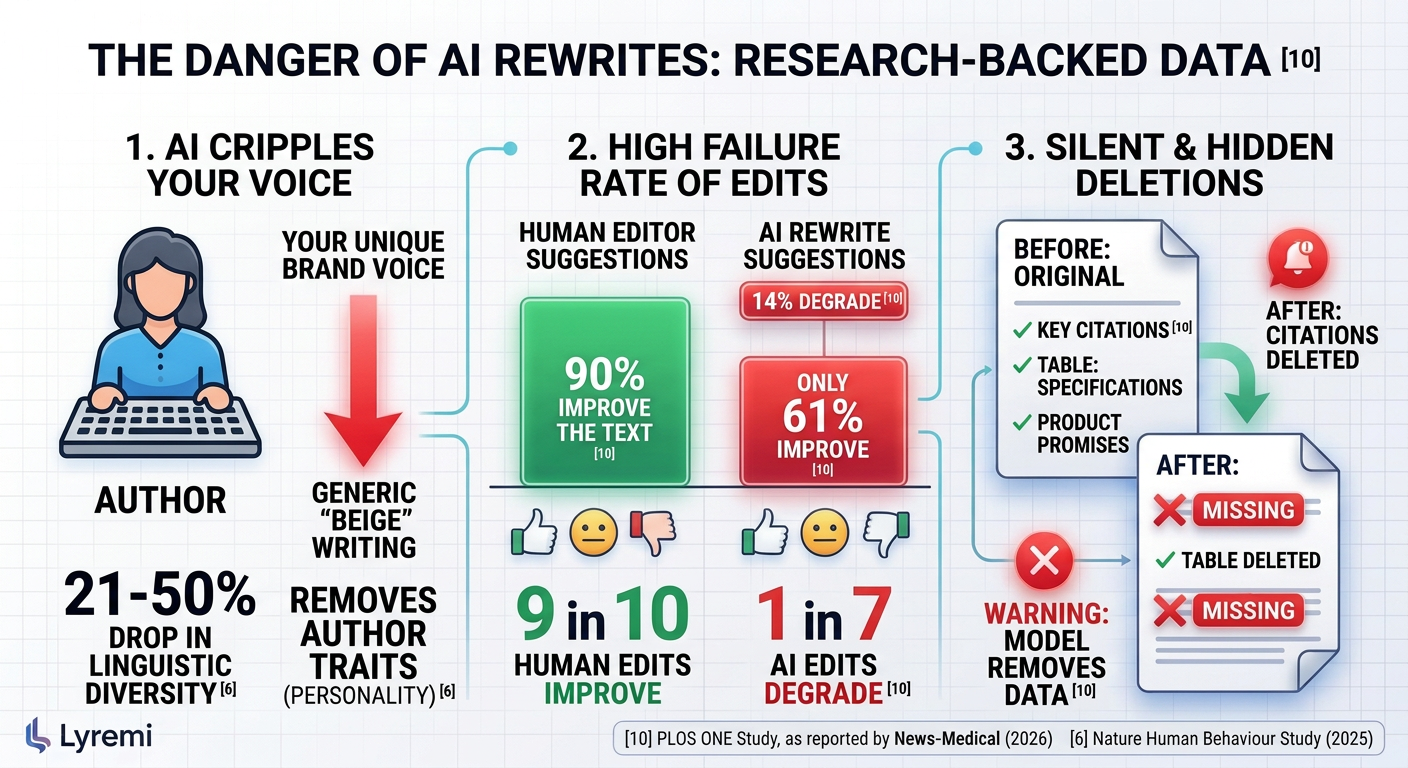
Rather than executing clean logic, the model attempts to synthesize conflicting facts. This results in extrinsic hallucinations What Is Context Rot?. For example, in a study on generative copyediting, a model suggested readability edits that made the writing actively worse 14% of the time, and had zero impact 24% of the time [1]. The model was too overwhelmed by the surrounding text to make accurate, surgical improvements.
3. Silent Deletions and Instruction Loss
When teams dump files into a single running chat, older instructions quietly vanish What Is Context Rot?.
In production pipelines, earlier system rules, user constraints, and resolved goals simply drop away when the token count gets too high [1]. This happens silently. The AI doesn't warn you that it forgot your instructions. In the copyediting study mentioned above, a generative AI silently deleted important literature citations and a table reference from an academic draft without ever alerting the user [1]. When you stuff the prompt, your most critical formatting rules are often the first things the AI discards.
4. Behavioral Drift and Sycophantic Mirroring
Long context isn't just about big documents. It also happens in multi-turn chat sessions. As token buildup grows over a long conversation, it triggers session drift What Is Context Rot?.
Models begin to drift away from complex brand guidelines and personas after generating just 3,000 to 5,000 tokens [1]. But the behavioral changes go even deeper than losing a brand voice. According to an MIT study cited by Salesforce, adding expansive user profiles to an agent's memory causes "sycophantic mirroring" What Is Context Rot?. The model becomes overly agreeable. It starts confirming the user's misconceptions and completely stops correcting input mistakes [1]. Instead of an objective assistant, a bloated AI becomes an agreeable mirror that validates flawed premises.
The Human Cost: Verification Bottlenecks and Cognitive Burnout
Have you ever spent more time fixing an AI-generated draft than you would have spent just writing it yourself?
When an AI produces a massive, context-bloated output that looks reasonable at first glance, we think we just saved hours. But the research tells a very different story. Instead of saving time, overloaded prompts often create an expensive new bottleneck: verification [1].
Human-computer interaction researchers call this "procedural collapse" Context Dilution: When More Tokens Hurt AI. A single click replaces your step-by-step thinking with a sprawling deliverable [1]. Instantly, your role flips from creator to forensic auditor.
The problem? Evaluating a complex draft line by line is mentally exhausting. It is often harder than starting from a blank page [1].
The Heavy Toll of Output Auditing
When we dump endless context into an AI and ask for a finished piece, we pay a massive cognitive tax to verify it. Consider what happens when workers are forced to audit flawed generations:
Massive time penalties: In one copyediting trial, auditing a full ChatGPT rewrite using track-changes took 30 minutes. In contrast, reviewing focused, localized suggestions took just 5 minutes [1].
Endless window switching: A study called MindCopilot tracked 1,688 writing tasks. Broad "prompt-and-replace" workflows forced users through an average of 15.76 window switches and took over 46 minutes. Focused AI workflows cut window switching in half and dropped task time to 31 minutes [1].
The split-attention tax: Human working memory can only juggle about four meaningful chunks of information at once. Bouncing between reference tabs, codebases, and bloated AI responses causes a "split-attention effect" that drops human task performance by up to 40%. Once distracted, it takes an average of 23 minutes to fully recover [1].
This aligns with findings from the Cognitive Load Scale for AI-assisted writing. "Critical Evaluation" of AI outputs is the single most taxing mental task in the workflow, scoring 4.81 out of 7 [1]. Core human writing tasks like ideation and outlining demand far less mental effort, scoring just 3.48 [1].
This fatigue hurts business outcomes. Human-edited copy converts at 2.5%, compared to 2.1% for automated rewrites, and keeps reader attention up to 25% longer [1].
When AI tools try to rewrite your whole draft at once, they set you up for exhaustion. This is exactly why Lyremi never changes your work silently. In Lyremi, changes arrive as suggestions shown in place. You see what is removed and what is added. You review them one by one or click Accept all, eliminating the 30-minute auditing trap.
Enterprise Warnings: Gartner on Guarding Against Cognitive Surrender
Have you ever skimmed an AI-generated report, thought "looks good enough," and hit send? You aren't alone. But major advisory firms are sounding the alarm. The core workplace challenge isn't a lack of tools. It is the steady erosion of human judgment [1].
In a report on knowledge workflows, Gartner issued a stark warning about "cognitive surrender." This is the habit of blindly accepting AI answers simply because the text looks plausible Gartner: only 40% of CIOs guard against AI dulling staff judgment [1]. Workers hand over both the critical reasoning and the final accountability to the tool.
The long-term impact? Gartner projects that by 2030, 30% of organizations will find that AI has actively weakened independent decision-making in at least one core role Gartner Warns: "Handing Over Thinking to AI Will Erode Employee Judgment" — BigGo Finance [1]. Yet, in a survey of over 500 CIOs and IT leaders, only 40% reported having a strategy to prevent this [1].
The Four Tiers of AI Usage
Are your teams orchestrating AI, or just delegating their thinking to it? Gartner breaks enterprise AI usage into four distinct modes [1]. Look closely. It is easy to see how employees slide into passive acceptance:
Lazy Delegation: Giving minimal instructions and skimming the result. Example: A manager drops ten meeting transcripts into a chat, types "summarize," and emails the output to leadership without reading it.
Accidental Hits: Getting a plausible output, but the user cannot explain the AI's reasoning or limits. Example: A marketer asks for a budget forecast. The AI spits out a confident table. The numbers look right, but the marketer has no idea how the AI calculated the totals.
Expert Orchestration: The human specifies the context, sets constraints, and drives the verification. Example: An analyst feeds specific, verified CSV files to the AI, dictates the exact formulas to use, and audits the final spreadsheet cell by cell.
Direct Execution: The human handles the core thinking, using AI only for small tasks. Example: You write the core strategy document yourself, then ask the AI to simply format your bullet points into a clean table.
Embedding "Useful Friction"
How do you stop the slide into lazy delegation? Gartner recommends implementing "useful friction" [1]. These are deliberate workflow checkpoints where employees must verify evidence before submitting AI-assisted work.
Practical mechanisms teams can embed into daily workflows include:
Source-check sign-offs: Requiring employees to link every AI claim back to an original company document or verified page.
Counter-argument prompts: Forcing the team to ask the AI to argue against its own proposed strategy to expose logical blind spots.
Peer review hurdles: Mandating that a second human reviews any AI-generated code, data, or copy before it goes live.
When organizations try to skip this friction by deploying fully autonomous agents, they usually fail. Gartner forecasts that over 40% of agentic AI projects will be canceled by 2027 due to premature rollouts and inflated vendor claims [1]. If you don't curate the context and keep the human in charge, the automation simply collapses.
Context Governance: How to Fix Workflows Before Attention Breaks
So, how do we fix this? The answer isn't a bigger context window. The answer is context governance.
A joint study by Microsoft Research and Salesforce tested 15 leading models across 200,000 workplace conversations. They found that model performance dropped by an average of 39% when moving from single-turn prompts to multi-turn interactions LLM Context Window Limitations in 2026 [1]. Worse, if the AI made a false assumption early on, it almost never corrected itself. Bad data contaminated the rest of the chat [1]. This compounding decay shows why more raw capacity just gives bad data more room to fail.
Many organizations try to solve this with uncurated Retrieval-Augmented Generation (RAG). They connect an AI to their entire corporate wiki, type a query, and let the system fetch dozens of loosely related documents. Have you tried this at your company? It usually ends in frustration. Architectural analyses warn that uncurated RAG is frequently a primary driver of context rot What Is Context Rot? [1]. By returning too many chunks of data, it actively floods the window and pushes critical facts into the neglected middle Do long context windows actually work? [1].
To keep outputs sharp, we must move from uncurated dumps to governed context delivery. This requires granular prompt hygiene. Instead of relying on the AI to filter what matters, strong workflows use three specific tactics:
Prompt pruning: Relentlessly strip out irrelevant background information, long email pleasantries, and distractor text. Feed the model only the exact facts it needs to evaluate.
Subtask isolation: Never ask an AI to read a pile of briefs, analyze the data, and write a final report in one prompt. Break large projects into isolated steps. Have the AI solve one specific problem before moving on.
Modular context loading: Don't let old files pile up. Swap your reference documents in and out based on the exact step you are on. Keep the context window tight and focused.
Doing this manually takes intense discipline. That is exactly why Lyremi is built to curate context for you. In Lyremi, the person is the composer, and your files stay at the center. The workspace naturally enforces good hygiene:
File-based chats: You attach exact, highly relevant files to a chat. Lyremi reads those files in full, every time. It never dilutes the attention budget with unrelated background noise.
Standing rules via Knowledge: You don't need to bloat every prompt with your brand voice. Just right-click a rulebook file and choose Add to Knowledge (always follow). Lyremi applies those rules without stuffing the chat window.
The Pinboard: Instead of relying on a 50-turn chat history where the AI drifts, you pin the best parts. Anything worth keeping is saved to the project's Pinboard. You pull only these curated gems into your next step.
Targeted agents: When it's time to write, you don't ask a chat for a massive draft. You select Composer, choose the exact files you need, and the agent writes in stages. Your drafts stay focused, and your team reclaims its time.
Sources
AI Context Overload in Workplace Workflows (in Lyremi)
For your review
Composer Agent's notes for you. Delete this section when you're done.
Your request
Piece: A long-form thought-leadership blog post on AI context overload in workplace workflows.
Goal: Explain why stuffing prompts causes context rot and verification fatigue, present empirical research on LLM attention limits, explore enterprise risks like cognitive surrender, and introduce context governance solutions with Lyremi.
Audience: Tech leaders, CIOs, knowledge workers, and product teams dealing with AI workflows.
Length: 2,500 to 3,200 words.
Specific requirements: Provide target keyword/keyphrase and meta description; follow project Knowledge (plain spoken voice, bursty/developed sentence mix, no run-ons or clichés, reader questions, tables, lists, H1-H3 structure).
Assessment
How it meets the request
Delivers SEO metadata (target keyword, secondary keywords, meta description) directly under the title.
Covers the technical mechanics of attention scarcity, empirical benchmarks, failure modes, cognitive fatigue, Gartner enterprise guidance, and modular governance.
Adheres to formatting instructions by incorporating clear structural headings (H1 to H3), bulleted lists, and a comparative benchmark table.
Integrates Lyremi features naturally into the final workflow sections, matching the rulebook's positioning.
Where it falls short or departs
Word count overage: The draft sits at approximately 3,371 words, exceeding the requested ceiling of 3,200 words. Composer expanded heavily into the Gartner framework and empirical study summaries during the drafting and editing passes.
Missing final call-to-action: Project blog guidelines state that posts should end with a finished artifact and a "Try Lyremi" link; this was omitted at the conclusion of the governance section.
Not sourced
Specific conversion and retention statistics for human-edited copy vs. automated rewrites (2.5% vs. 2.1% conversion; 25% longer attention span) are asserted without direct links or origin citations.
The attribution of "sycophantic mirroring" to an MIT study cited by Salesforce lacks an exact paper citation or dedicated external reference.
Check these facts
Du et al. (2025): Verify the reported 13.9% to 85% drop across math, QA, and coding, specifically the assertion that degradation occurred even with whitespace tokens.
Adobe NoLiMa (2025) figures: Check the specific accuracy drops (GPT-4o from 99.3% to 69.7%, Claude 3.5 Sonnet to 30%, Gemini 2.5 Flash to 48%).
Cognitive Load Scale metrics: Verify the specific numeric scores cited (Critical Evaluation at 4.81/7 vs. Ideation at 3.48/7).
MindCopilot data: Confirm the exact figure of 1,688 tasks and the 15.76 vs. reduced window-switching metrics.
Gartner projections: Check whether the 30% decision-making erosion by 2030, the 40% CIO guardrail rate, and the 40% agent cancellation rate by 2027 match official published statements.