



Bear with me, this article starts out as one of my mini rants.
The Disappearing Context: How Long Chats Break Your Content Strategy
I have spent over a decade managing organic search campaigns, building content strategies, and editing professional writers. Over those ten years, I watched dozens of content trends surge and fade. Then, in late 2022, large language models hit the mainstream. Like almost every content marketer I know, I jumped in. We were promised a revolution in drafting speed, research synthesis, and workflow efficiency.
At first, working inside a standard chat window felt like magic. You paste in an outline, feed the assistant your target keywords, add your audience profile, and provide a style guide. The first response usually looks sharp. The tone is right on target, and the facts line up.
Then you get down to real work.
Long-form content is not a one-prompt job. A comprehensive pillar page or a 2,500-word technical guide requires multiple iterations. You ask the model to draft the introduction, flesh out section two, and integrate secondary search intent. But by the fourth or fifth message, something breaks.
Have you noticed how quickly an AI assistant loses its grip during a long project?
The prose flattens out into bland, generic corporate sludge. The model forgets your negative constraints. It starts using the exact buzzwords you banned in your very first prompt. If you told it never to say "delve" or "landscape," you suddenly find those exact words creeping back into every paragraph.
Even worse, your key strategic angles vanish. The tool drops the core thesis you outlined twenty minutes earlier. You find yourself scrolling up, copying your original instructions, and pasting them back into the chat box. You hit enter, hoping to jog its memory.
It feels like working with an assistant who suffers from immediate short-term amnesia. Most marketers blame themselves. They assume their prompts are too messy or that they need to study more prompt engineering tricks.
They are wrong. The breakdown is not user error. It is a fundamental architectural flaw in how large language models process information.
What Is the LLM Lost in the Middle Problem?
When an AI drops your editorial rules, it is not acting out of malice or random chance. It is exhibiting a documented phenomenon known as the llm lost in the middle problem.
In a landmark research paper titled Lost in the Middle: How Language Models Use Long Contexts, a research team from Stanford University, UC Berkeley, and Samaya AI uncovered this exact behavioral breakdown. First released as an arXiv preprint in July 2023 and formally published in the Transactions of the Association for Computational Linguistics (TACL) in 2024, the study investigated how frontier models actually handle information placed throughout long prompts. The authors included Nelson F. Liu, Kevin Lin, John Hewitt, Ashwin Paranjape, Michele Bevilacqua, Fabio Petroni, and Percy Liang, with their work archived across platforms like the Hugging Face paper repository.
To measure context utilization, the researchers evaluated models using two distinct tests:
Multi-Document Question Answering (QA): The model was given an input prompt containing a specific query alongside k documents (typically 10 to 20 documents). Only one single document contained the correct answer, while the remaining files served as distractors. The researchers systematically shifted the position of the answer document from the very beginning to the absolute end of the input text.
Key-Value (KV) Retrieval: The model received a synthetic dictionary of key-value pairs and was tasked with extracting the specific value associated with an assigned key.
The researchers tested the leading commercial and open-source models of the era, including GPT-3.5-Turbo-16k, GPT-4, Anthropic's Claude 1.3 (100k), and Llama 2 variants.
Every single model produced a distinct, U-shaped performance curve.
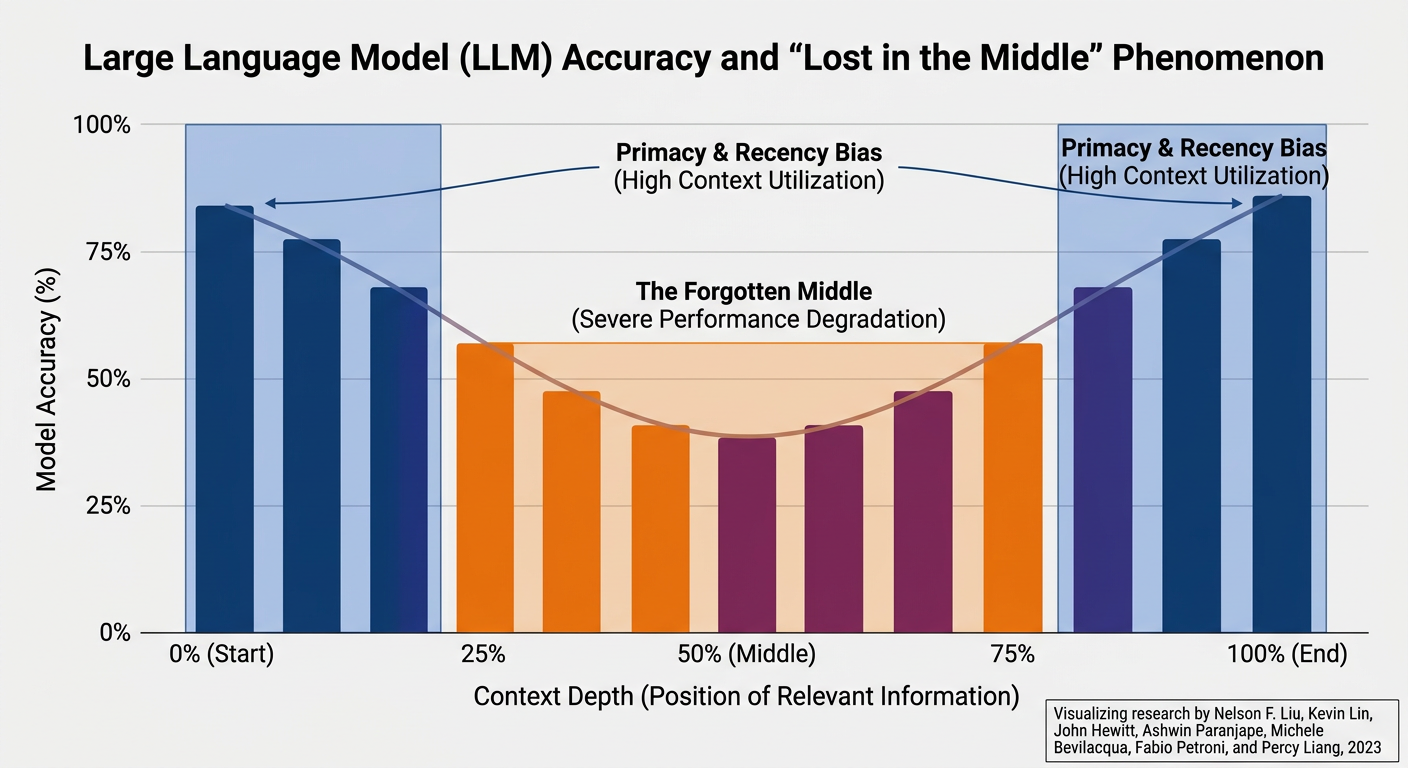
Accuracy is highest when the target data sits at the very beginning of the context (primacy bias) or at the very end (recency bias). But when relevant information is buried in the middle of the prompt—roughly between the 25% and 75% marks—performance drops dramatically.
According to an analysis of long-context recall by Pristren, accuracy dropped by 15 to 25 percentage points when the answer-bearing document moved to the middle of the input. In one 20-document experiment, models that achieved over 70% accuracy when the needle was in the first document plummeted to under 50% accuracy when that exact same needle was moved into the center of the stack.
Why does this happen? The answer lies in how Transformer self-attention functions.
Tokens at the beginning of an input prompt are attended to by every single token that follows them. Meanwhile, tokens at the end of the prompt benefit from recency during autoregressive generation. The tokens sitting in the middle receive fewer direct attention calculations on average. Furthermore, during decoding, the Key-Value (KV) cache for middle tokens is accessed less effectively.
This dynamic exposes the context window fallacy. Just because a model advertises a 16K, 32K, 100K, or even 1-million-token context window does not mean it treats all tokens equally. Capacity does not equal comprehension.
When you run a long drafting session in a standard chat, your initial brand guidelines, style rules, and source documents naturally slide down the context window as you talk. Soon enough, they land squarely in the forgotten middle. The model does not ignore you on purpose. Mechanically, it just goes blind.
The Hidden Costs: Token Bloat, Forensic Reading, and Brand Voice Drift
When the llm lost in the middle problem strikes an enterprise content team, it does not just produce awkward phrasing. It introduces severe operational and financial costs.
As an SEO lead, my job is to create scalable, repeatable processes that protect brand authority while hitting publication targets. When you build long-form content on top of an unstable, conversational context window, your production pipeline suffers in three major areas.
1. Token Bloat and Compounding Computational Waste
How do most writers react when an AI forgets their guidelines? They copy and paste their instructions again.
This practice, known as prompt stuffing, creates massive token bloat. If your brand voice sheet, formatting rules, and audience profiles take up 2,000 tokens, and you paste that text into every prompt across a twenty-message drafting session, you are paying for those same tokens over and over.
Bottleneck | Description |
|---|---|
Latency drag | Every additional thousand tokens increases processing time. Your rapid drafting assistant slows down to a crawl |
Financial penalties | Standard API models charge for every input token on every call. Repasting your rules into an expanding chat window burns through credit allowances and monthly budgets at an alarming rate |
Context crowding | Paradoxically, stuffing more rules into the prompt pushes your actual research materials and source documents further into the dead zone in the middle |
2. Brand Voice Drift and Editorial Homogenization
Brand voice is your main defense against generic search content. If your articles read like every other AI-generated post on the search results page, your organic rankings and user engagement will drop.
When an LLM loses track of your voice constraints in the middle of a chat thread, it falls back on default pretraining patterns. It defaults to predictable syntax, passive structures, and common AI tropes. Your piece starts sounding like an algorithmic average rather than an authoritative point of view.
If you are an agency managing five distinct client brands, session drift turns into a full-blown quality control crisis. One client's casual, punchy B2C voice slowly morphs into the stiff, bloated B2B jargon of another because the conversational chat history diluted the core instructions.
3. Forensic Reading and Verification Fatigue
The most exhausting toll of context amnesia is mental fatigue.
When a human copywriter submits an updated draft, they highlight their revisions or leave comments explaining what changed. But standard AI chatbots do not work that way. When an AI forgets your instructions or tries to revise an article, it typically spits out an entirely new draft all at once.
This forces you into what I call forensic reading.
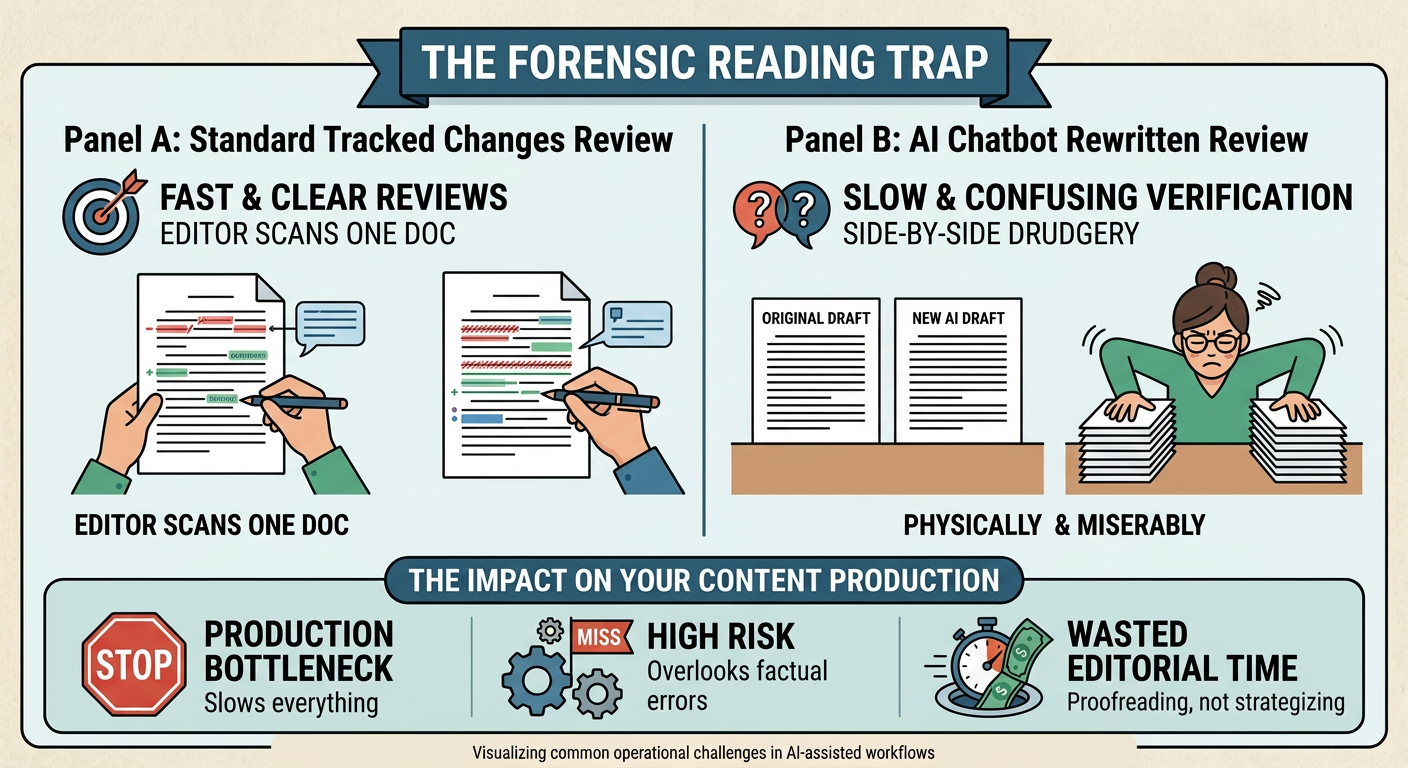
You have to pull up two windows side by side and read every single sentence to figure out what the machine kept, what it removed, and what it quietly hallucinated. Did it drop that crucial technical specification from your product brief? Did it preserve your internal linking targets? Did it quietly alter a verified statistic?
Forensic reading completely eliminates the time savings of using AI. Instead of spending your energy on high-level content strategy, you spend hours acting as an unpaid proofreader, hunting down errors caused by a model that forgot what you said five minutes ago.
Operational Cost | How It Happens | The Business Impact |
|---|---|---|
Token Bloat | Repasting guidelines into long chat threads to fight memory loss. | Higher API costs, slower generations, and rapid allowance consumption. |
Brand Voice Drift | Style constraints sink into the 40%–60% context zone and get ignored. | Homogenized copy, repetitive AI phrasing, and lost organic brand differentiation. |
Forensic Reading | Chat assistants rewrite whole documents instead of proposing targeted edits. | Severe verification fatigue, editorial bottlenecks, and missed factual errors. |
Why Standard RAG Snippets and Vector Chunks Make It Worse
To bypass the context limits of chat prompts, many enterprise marketing teams turn to Retrieval-Augmented Generation (RAG).
On paper, RAG sounds like the ultimate solution to the llm lost in the middle problem. Instead of stuffing an entire 50-page brand guide or a stack of dense industry PDFs into your prompt, you upload them to a vector database. The system converts your documents into mathematical vector embeddings. When you ask a question, the system searches the database, retrieves relevant snippets, and injects only those specific paragraphs into the prompt.
It sounds clean and efficient. But if you have ever used a standard RAG-powered writing tool to draft long-form content, you know that the results are often disjointed and contradictory.
Standard RAG does not fix context amnesia for long-form writing. In fact, it often makes it worse.
The Chunking Problem
Vector databases do not understand documents as complete, unified pieces of writing. To store information, they slice your text into arbitrary chunks—typically 300 to 500 tokens each.
Think about how an editorial style guide or a detailed case study is structured. What happens if a critical negative constraint sits on page two, but the stylistic examples sit on page eight?
For example, your brand guide might state on page two:
"Under no circumstances should we mention Feature X as an automated tool; it is strictly an assisted workflow."
Then, on page eight, your guide provides sample copy demonstrating how to talk about workflow speed.
When the RAG system processes your request to "write a feature overview about workflow speed," it performs a semantic similarity search. It fetches the chunk from page eight because the vocabulary matches your query. But because the negative constraint on page two lacks those specific semantic keywords, the vector search skips it.
The model writes the draft using the isolated snippet from page eight, completely unaware that it just broke a mandatory brand rule from page two.
Fragmented Narrative Structure
Writing an engaging, high-ranking article is an exercise in structural flow. Arguments build on previous paragraphs. Concepts introduced in the introduction must resolve naturally in the conclusion.
Standard RAG breaks this continuity:
Contextual blindness: Slicing documents into disjointed vector chunks strips out the surrounding context. The AI receives isolated puzzle pieces without the picture on the box.
Middle-stack insertion: When a RAG system retrieves five or ten different chunks from your files, it stacks them into the prompt. Which chunks end up in the middle of that retrieved list? The lower-priority or secondary ones. And as Liu et al. demonstrated in their research paper, information sitting in the middle of retrieved passages experiences immediate attention decay.
Tone fragmentation: Because the model only sees isolated snippets rather than the full flow of your source files, the draft lacks a unified voice. One section sounds like an academic white paper, while the next sounds like a landing page headline.
RAG is fantastic for quick fact lookup. If you ask, "What was our ARR in Q3?" a vector search can pull that single number accurately. But long-form content creation is not simple fact retrieval. It requires deep context, consistent voice, and narrative cohesion. Slicing your files into blind vector snippets destroys the very context your content needs to succeed.
From Prompt Stuffing to Context Engineering: An Architectural Shift
For years, my standard fix for degraded AI copy was painfully simple: add more words to the prompt. If the model drifted, I pasted my tone rules again. If it churned out robotic filler, I added an angry paragraph forbidding marketing buzzwords.
Have you ever found yourself doing that? I have.
In content marketing, we call that prompt stuffing. It feels productive right up until you check the draft. Every time you paste a twenty-page style guide into a chat box, you push your earlier conversation deeper into the prompt's memory. As your conversation stretches across ten or fifteen exchanges, your core instructions slide directly into the middle of the context window. The model begins dropping the very guardrails you just typed.
Prompt engineering tries to cure memory loss with clever phrasing. Context engineering fixes the problem by redesigning the workspace itself.
Instead of treating the model like a disposable scratchpad, context architecture separates your standing rules from your daily requests. Your brand standards, negative constraints, and audience profiles sit in a permanent layer above the chat. The model does not have to hunt for your voice in a messy thread.
Dimension | Prompt Stuffing (Ad-Hoc Chat) | Context Architecture (Structured Workspace) |
|---|---|---|
Instruction Location | Pasted directly into the chat box. | Anchored permanently at the project level. |
Memory Degradation | Rules slide into the middle and get ignored. | Rules stay active across every prompt and draft. |
Token Cost | Re-sends thousands of tokens with every message. | Caches full documents to cut processing costs. |
Editorial Control | Destructive rewrites replace your copy blindly. | Revisions arrive as clear inline suggestions. |
When you stop treating context like throwaway chatter, you protect your content from attention decay.
How Lyremi Fixes Context Amnesia with Whole-File Grounding and Knowledge
This architectural shift is why I built Lyremi and moved my workflow into it. Most writing platforms trap you in an isolated prompt box. Lyremi puts your original files right at the center of the workspace.
To eliminate the LLM lost in the middle problem, Lyremi uses a dedicated project layer called Knowledge.
Knowledge sits permanently above your conversations. Because it lives at the project level, it never slips into the forgotten middle of a long conversation. It works through two straightforward controls:
Rulebooks: Bring your existing brand voice sheet, editorial guidelines, or client brief into your project. Right-click the file and select Add to Knowledge (always follow). Lyremi marks it as a Rulebook and reads the entire document before executing any writing task in that project.
Instructions: Open the project's Knowledge panel and type a few standing lines. This is where you specify your audience, set your tone, or list specific expressions you want the AI to avoid.
From that moment on, your chats show Following … Knowledge. The operating rule is simple: your chat request decides what to write, while Knowledge governs how to write it.
What about cost? If an AI re-reads a 20-page brand guide on every turn, your token usage usually spikes.
Lyremi handles this with smart context caching. When Composer Agent writes a piece, it caches your source files, Knowledge rulebooks, and research findings once per run. Each subsequent writing pass reads that cached material at roughly one-tenth the standard computational cost.
Most importantly, Lyremi reads attached files in full every time (when you instruct it to). It bypasses blind vector chunking. Your negative constraints, data tables, and structural nuances stay linked from start to finish.
Step-by-Step: Keeping Long-Form Work Grounded in Your Workspace
How do you set this up for your next long-form article or client deliverable? You do not need to write code or configure complex APIs. You just organize your files.
Here is the exact step-by-step workflow to keep your content grounded:
Bring in your source files. Create a project in the explorer. Upload your background research, client notes, data sheets, and style guide PDFs.
Anchor your standing Knowledge. Right-click your style guide and choose Add to Knowledge (always follow). Open the project Knowledge row and add two or three direct lines defining your audience and forbidden expressions.
Run your agent pipeline. Run Research Agent to gather web sources with verified citations. When you are ready to write, launch Composer Agent to turn your files, Knowledge rules, and cited research into a completed draft.
Review non-destructive edits. When you ask for adjustments, Lyremi never overwrites your draft in secret. Edits arrive as clear suggestions showing additions and removals in place. You accept or reject each change individually.
Why spend your week pasting the same guidelines into a chat box that forgets them ten minutes later?
When your files stay at the center, you sidestep context decay entirely. You protect your brand voice, avoid forensic editing, and keep total ownership over every sentence.
Take a look at About Lyremi to see the file-centered workspace in action, or test your first rulebook on the Free plan today.